Around this time of year, a lot of runners are actually standing at the start of a new season without quite realizing it. The spring races are done, the autumn and winter marathons aren't open for sign-ups yet, or the lottery just closed. Nothing dramatic seems to be happening — but honestly, how your next race goes is largely decided by what you do in these quiet weeks right now.
The trouble is, most people don't train that way. The usual move is to grab a "16-week marathon plan" two or three months out, paste it in, and put your head down. That's not wrong, exactly. But you'll notice it skips a more important question: before that plan even begins, what are you supposed to be doing?
So in this piece we're going to take a full marathon training cycle apart: which phases it breaks into, what each one is for, why the order can't be shuffled, and why "just follow the plan" sometimes ends up breaking people. Once this clicks, you stop seeing training as a pile of scattered workouts and start seeing it as one continuous road that gradually carries you to the start line.
Why does your "next race" actually start now?
Because the effect of training is built up layer by layer — it isn't crammed in at the last minute before a race. That's the whole idea behind periodization: you take a long stretch of training and split it into phases by purpose, so your body builds a base first, takes on intensity next, and arrives on race day with form dialed all the way up.
Think of it like building a house. You wouldn't rush straight to the furniture and the paint — you have to get the foundation and the frame right first, or the nice-looking stuff has nothing to sit on. Training is the same. If your aerobic base isn't solid yet and you cram in a load of intervals and tempo runs, the plan looks "serious" on paper, but your body can't absorb it. What you usually get isn't progress — it's fatigue piling up until something suddenly stalls, or you just get hurt.
So rather than asking "what should I do before the race," it's better to first ask "where am I in the whole cycle right now." Lay the timeline out flat, and you'll realize these few low-key weeks are anything but blank space.
What phases does a full training cycle break into?
A race-focused training cycle usually splits into four or five phases. Everyone names them slightly differently, but the skeleton is much the same. In plain terms, it's these:
- Base phase: grow the aerobic engine with lots of easy running to lay down an endurance floor — and this is exactly what you should be doing right now.
- Build phase: on top of that base, start adding threshold and tempo work to lift the engine's working speed.
- Peak phase: training looks more and more like the race itself, and you start sharpening the actual goal pace you'll run.
- Taper: deliberately bring volume down so accumulated fatigue clears and your real fitness rises to the surface by race day.
- Transition: recovery and reset after the race, which also rolls into the start of the next cycle.
Here's the crucial bit that often gets ignored: the order of these phases can't be casually swapped. Intensity is always built on top of a base, and goal pace is always sharpened on top of intensity you've already established. You can't skip the base and start from the peak — and even if you force it, your body won't absorb it. So let's walk through them in order.
Base: the phase you most need now, and the one most often skipped
The base phase has exactly one job: make your aerobic base thick. The star of the show here is a high volume of steady, genuinely easy running, with just a little intensity sprinkled in. It sounds boring, and frankly it isn't very dramatic — but it more or less decides how much training you'll be able to handle later.
Why does it matter so much? Because aerobic fitness improves slowly; it needs time and accumulation, and it can't be rushed. More mitochondria, denser capillaries, a heart that pushes out more blood per beat — all the deep adaptations that let you "run long without falling apart" have to be built up through long stretches of low intensity. They can't be crash-built in the weeks before a race, which is exactly why they belong now, when you're furthest from race day and most patient.
The most common mistake in this phase isn't doing too little — it's running your easy runs too fast. A lot of people say they're base-building while quietly nudging every easy run into moderate intensity, so the aerobic base never really thickens and the fatigue stacks up instead. Put bluntly: in the base phase, running "easy enough" matters far more than running "fast enough."
Build: lifting the engine's working speed
Once the aerobic base is laid, the build phase steps in. Now the plan starts adding intensity — threshold runs, tempo runs, and well-controlled intervals. The goal is to take an engine that's already big and push its efficiency and ceiling higher. Put another way, the base phase makes the fuel tank bigger; the build phase lets you burn that fuel at a faster speed.
This is exactly why the order can't be reversed. If you pile on intensity before the base is ready, your body doesn't have enough recovery capacity to absorb those sessions, so instead of becoming progress, they become risk. Methods like Hansons, Norwegian double-threshold, and polarized training mainly differ in how intensity is distributed and how the threshold work is arranged — but they share one prerequisite: a thick enough aerobic base underneath. (We compare those methods in more detail in another article.)
The build phase has another easy trap: greed. Once you feel yourself running well, it's tempting to make every session a little faster, a little longer. But you'll find that what actually drives progress is never squeezing every workout dry — it's pairing a meaningful dose of stimulus with enough recovery. Getting that balance right is often what decides whether the build phase makes you or breaks you.
Peak and taper: don't break yourself in the last mile
In the peak phase, training looks more and more like the race itself. Long runs start including chunks at goal marathon pace so your body gets familiar with what race day actually feels like. Volume is usually still high here and intensity is near the cycle's ceiling, so honestly it gets pretty tiring — but this is precisely where you assemble all the parts into "race form."
Then comes the most counterintuitive yet most important part: the taper. In the one to three weeks before the race, your job is to deliberately bring volume down. Note carefully — you're cutting the volume, not the intensity. You keep some short, fast work to stay sharp, but the total clearly drops. The aim is singular: clear out the fatigue this whole block has accumulated so your real fitness can surface.
The sport science on this is actually quite clear. Reviews pulling together a couple dozen taper studies land on roughly this: cut training volume by about 40–60% while holding intensity, and you typically gain around 2–3% in performance. The key is that word "holding" — research also finds that if you cut intensity too, the adaptations you built start to fade. That's why the taper part of the chart shows volume dropping while the intensity line stays up — it isn't a mistake, it's the whole point of tapering.
The classic mental hurdle here is, "I trained this hard, won't running less make me lose it?" Honestly, almost never. The training effect is already banked in your body. The taper doesn't make you weaker — it lifts the layer of fatigue sitting on top of your fitness. Plenty of people just can't bring themselves to cut back, grind right up to race day, and end up on the start line carrying a load of fatigue, wasting months of work. And the ones who fall into this trap are often the most diligent runners of all.
So why does "just follow the plan" still break people?
By now you might be thinking: so I just grab a ready-made periodized plan and follow it obediently — done, right? In theory, yes. In practice it's not that simple, because a pre-written plan doesn't know how "the real you" is doing this week.
It doesn't know you were buried in work and badly short on sleep this week; doesn't know your last long run was harder than expected and you recovered slowly; doesn't know you missed several days to travel, weather, or a niggle. But every one of those genuinely affects how much training you "should" take on this week. The same plan run on a good week is progress; run on a wrecked week, it's often the last straw that breaks you.
That's why knowing the "order of the phases" isn't enough on its own. The hard part is constantly judging how much load suits you right now — whether this week you should push on or pull back a little. Sport science has concepts like ACWR (acute-to-chronic workload ratio) precisely to quantify "is your recent training volume ramping too fast relative to what your body is already used to." Periodization tells you the direction; load management tells you how hard you can press today. Cover both, and the road stays steady.
How Paceriz helps you see where you are in the cycle
This is exactly what Paceriz does. We don't just hand you a plan — we read every piece of your real training (pace, heart rate, volume, recovery) and help you judge whether you're currently base-building, adding intensity, or already due to cut volume and prep for the race.
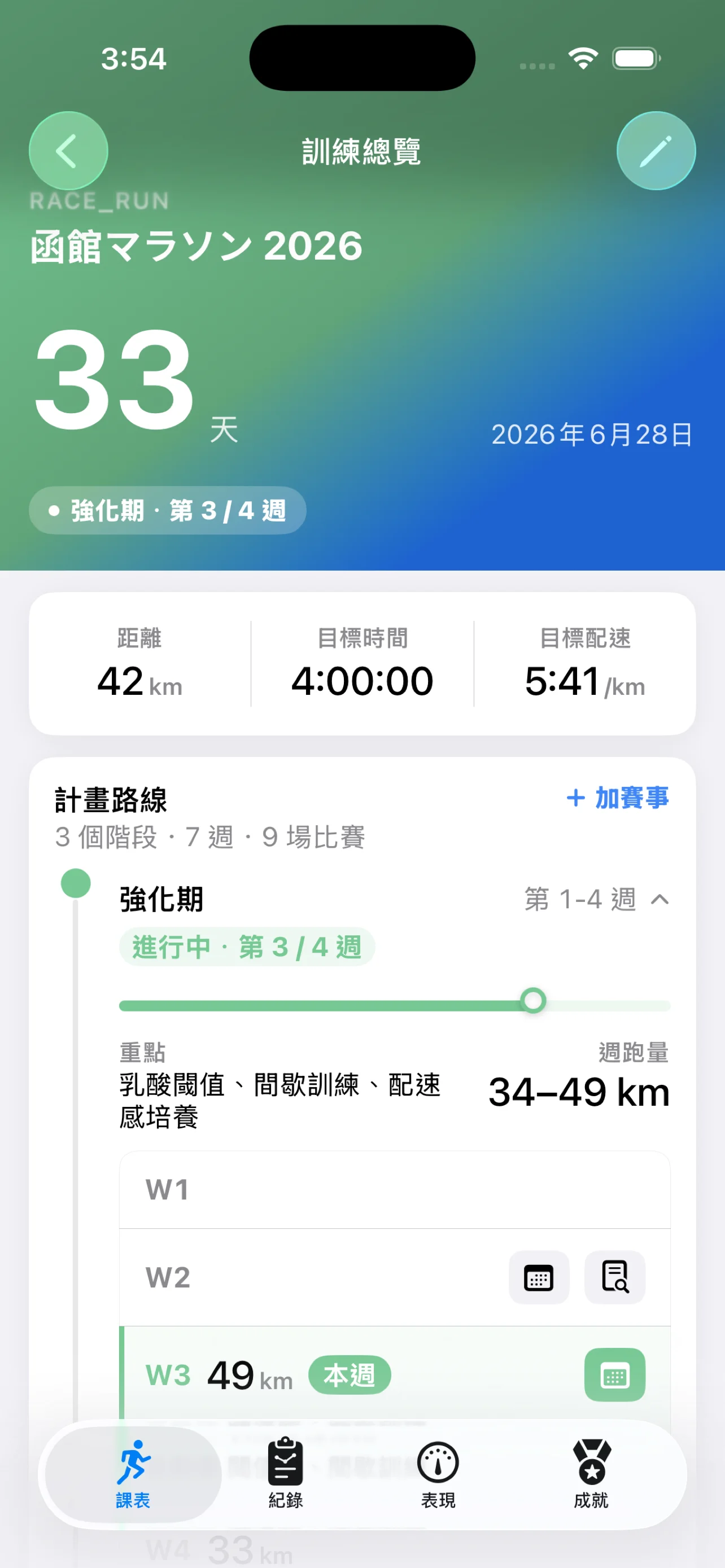
More importantly, it adjusts to your real state instead of telling you to swallow the plan whole no matter how you're doing. When you're tired and your volume has dropped, it pulls the load back into a safe range and eases you back in, rather than forcing you upward; when you're steady and your base is solid, it lets you push. In the end, the value of periodization isn't "having a very complete plan" — it's a plan that always knows where you are and where you should head next.
So if you're asking what to do with this race-less, slightly flat stretch right now — the answer is that it's the part of your whole next season you should take most seriously. Lay the base, reconnect with your rhythm, and leave the rest to be stacked up over time.
Make every week of training know which phase it's serving
Use Paceriz to see whether you're base-building, adding intensity, or prepping to race — and get the right load for your real state
Try it free